

The architectural history of Philadelphia is a fascinating combination of technical triumph and an informal cultural code. While late 19th-century engineering reached its peak by creating the world’s tallest stone tower, the city simultaneously adopted an unwritten law that froze its vertical ambition for decades.
This paradox poses an intriguing question: why did developers, with the technical capability to build higher, voluntarily submit to a “gentlemen’s agreement” that prohibited any structure from eclipsing the hat of William Penn? This is a story of how respect for historical heritage and mythological belief proved stronger than market forces and economic expediency, shaping an entirely unique, low city skyline that lasted for almost a century. We explore the details at philadelphia.name.
The Unwritten Rule of Height
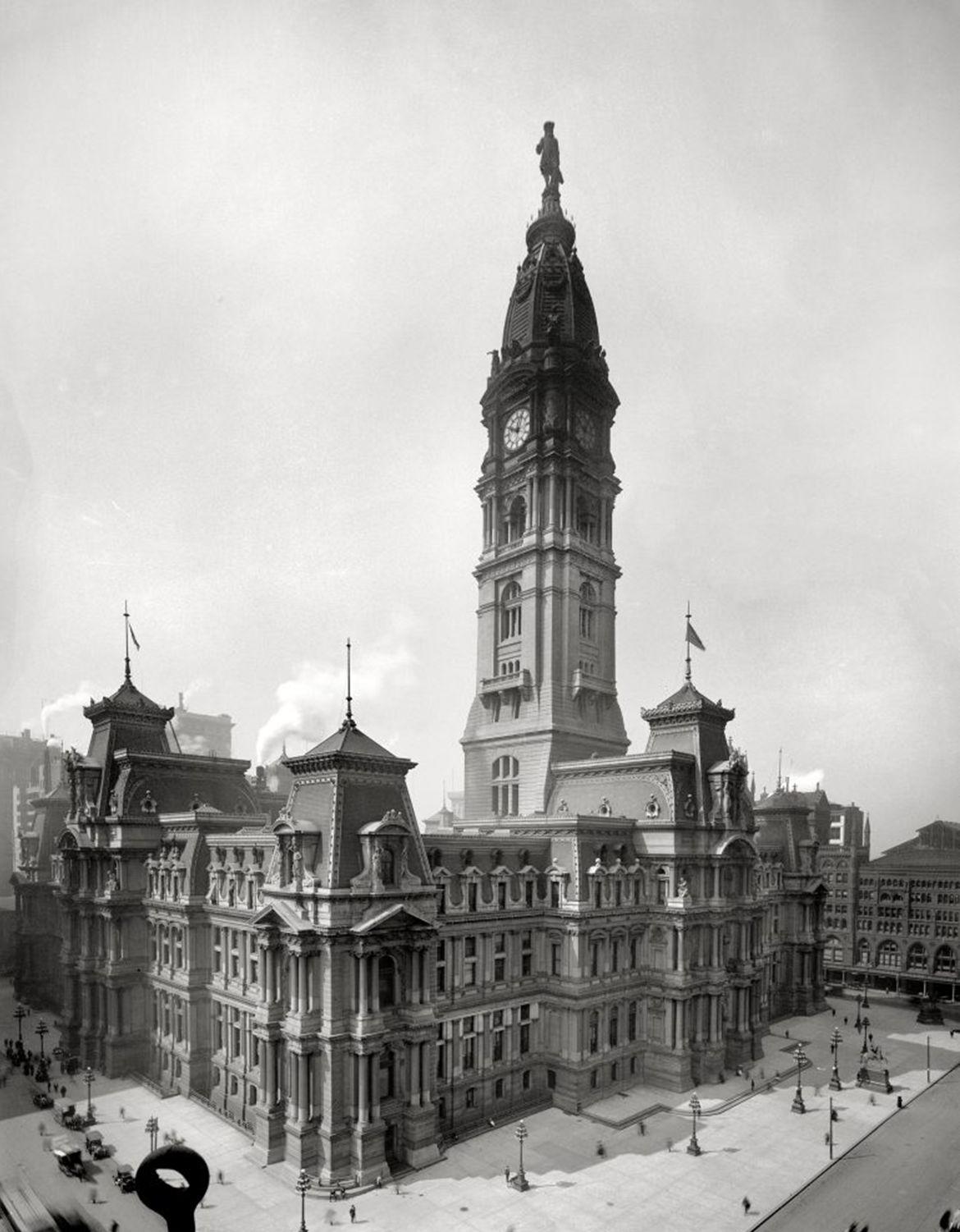
The Philadelphia legend about the sanctity of its skyline began in 1901, immediately after the completion of the monumental City Hall. This massive stone structure, which rose from stone blocks in the city center, was crowned with a magnificent symbol: the eleven-meter bronze statue of William Penn. This vertical limit became the basis for the “Gentlemen’s Agreement”—an informal understanding that shaped the urban center’s appearance for eight decades. The rule’s core was simple yet deeply symbolic: no new commercial project was allowed to rise above the height of Pennsylvania’s founder’s hat, which stood at approximately 167 meters (ca. 548 ft.).
This traditional taboo was not enshrined in municipal codes, but it was strictly adhered to by the city’s leading developers and architects. The goal of this architectural self-restraint went beyond mere historical respect. It was a conscious choice to preserve the visual dominance of City Hall as the central symbol of power and civic identity. While other major American metropolises, such as New York and Chicago, engaged in a relentless race for height, building ever-taller skyscrapers, Philadelphia maintained a unique equilibrium. Its panorama remained relatively low and horizontally developed, and the City Hall’s silhouette remained the undisputed king. This cultural phenomenon gave the city a special charm but, at the same time, constrained its economic potential, turning an unwritten rule into an architectural boundary that sparked intrigue and impatience among a new generation of developers.
Engineering Compromises
Adhering to “Penn’s Law” created extremely specific challenges for Philadelphia’s structural engineers and urban planners. Architects in Philadelphia were forced to focus on the maximum efficiency of horizontal and limited vertical space.
This limitation spurred significant engineering creativity. Instead of a simple height competition, designers had to find ways to optimize the building footprint and the efficiency of every cubic meter. High-rise structures built in the 1960s and 1970s, including the famous PSFS Building, which became the city’s first modern skyscraper, were constructed to maximally use the allowed vertical limit but not cross the symbolic threshold of Penn’s hat.
The implementation of these projects required jeweler-like precision in calculations. Engineers had to develop creative solutions for designing mechanical systems, utilities, and elevator cores to fit the necessary functionality (offices, residential space, mechanical floors) into a strictly limited volume. Simultaneously, structures had to be optimized for seismic stability and wind load resistance—critical factors for any high-rise building, even a limited one.
Thus, “Penn’s Law” became not an obstacle but a catalyst for refined engineering solutions and an innovative approach to design, where quality took precedence over the number of floors.
Breaking the Taboo
The unwritten “Penn’s Law” could not last forever. By the late 1980s, the pressure of economic development became too strong. Philadelphia urgently needed modern office space. The old agreement, though revered, became an impediment to urban progress.
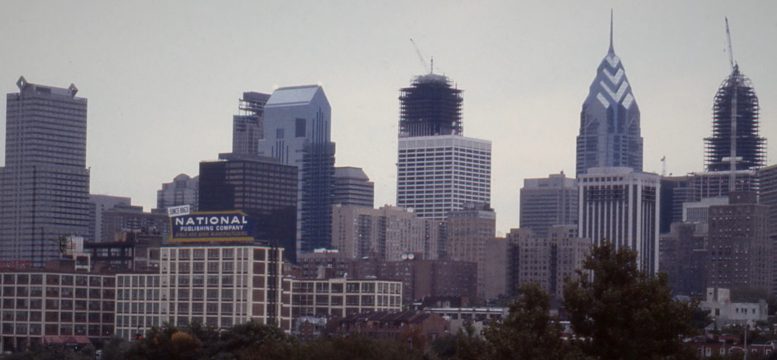
In 1987, the official break from the taboo occurred. The first structure to defiantly exceed the height of Penn’s hat was the One Liberty Place skyscraper. Its completion caused a massive stir among residents and architects. It signaled the end of the era of stone supremacy.
From an engineering standpoint, One Liberty Place was a symbol of a new age. Its structural feature was the use of modern steel frames and composite materials. This technology allowed builders to safely erect a tower reaching 288 meters (ca. 945 ft.). This skyscraper significantly surpassed the ancient stone City Hall. Following this architectural breakthrough, the city entered an era of intensive high-rise construction. The resulting development led to a sudden and irreversible change in Philadelphia’s skyline, transforming it into a modern metropolis.
The Curse of Penn
The violation of the architectural rule gave rise to a unique cultural phenomenon known as the “Curse of Penn.” This urban legend quickly gained traction, claiming that none of Philadelphia’s four major sports teams (Eagles, Phillies, Flyers, 76ers) would win a championship until the city’s tallest building no longer towered over the bronze statue of William Penn.
This belief, which lacks any logical or scientific basis, clearly emphasizes how deeply City Hall and its founder are rooted in local identity. The sports failures, which coincided with the arrival of One Liberty Place, quickly turned into a mythological punishment for breaking the unwritten architectural pact.
The “Curse” lasted until 2008. That year, the Philadelphia Phillies finally won the World Series in baseball, putting an end to decades of athletic disappointment. This victory came after a miniature statue of Penn was secretly placed atop the newly constructed tallest skyscraper in the city (the Comcast Center), supposedly to “restore balance” and respect for the founder. This touching anecdote perfectly illustrates how engineering innovation, meaning the rapid vertical construction, inevitably collided with local folklore—a unique feature of Philadelphia’s history.

Megastructures of a New Type
Modern high-rise construction in Philadelphia has completely moved past the stone limitations of the 19th century. Engineering projects now focus on maximum spatial efficiency and environmental sustainability.
Examples of engineering solutions in new skyscrapers.
- High-strength concrete and composite materials for weight reduction.
- Tuned Mass Dampers for active oscillation suppression to stabilize against wind loads.
- Integration of green technologies and energy-efficient facades (Comcast Technology Center).
Today, the dominant structure is the Comcast Technology Center (completed in 2018) at 342 meters (ca. 1,122 ft.). This technological giant is a testament to how engineering progress has reshaped the city’s architectural landscape, definitively concluding the era of the “Gentlemen’s Agreement.”

Chronology of High-Rise Engineering
| Era | Key Structure | Restriction / Principle | Engineering Solution |
| Late 19th Century | City Hall (1901) | Masonry construction, no steel frame. | Massive walls and supports, record for the tallest masonry building. |
| 1901 – 1987 | PSFS Building, Bell Atlantic Tower | “Gentlemen’s Agreement” (below Penn’s statue, 167 m). | Optimization of horizontal space, precise height control. |
| 1987 | One Liberty Place | Violation of “Penn’s Law” and the start of a new era. | Steel frame, construction to a height of 288 meters. |
| Modern Era | Comcast Technology Center (2018) | Environmental sustainability and energy efficiency. | Integrated wind management systems, high-strength composites. |
