

In Philadelphia, in the old days, there was a facility that provided the citizens with drinking water. The historic building then performed a vital function for the entire region along the banks of the Schuylkill River. However, the water supply lost its importance as a result of industrialization. More curious facts about Pennsylvania’s first and one of America’s oldest waterworks you can find at philadelphia.name.
Background, establishment and development of the facility
In the early nineteenth century, Philadelphia was being ravaged by a terrible yellow fever epidemic, which killed more than a thousand citizens. Dirty water was one of the main causes of disease exacerbation at that time. Local authorities decided to tackle this problem. They searched for clean water sources and even built two steam engines that supplied river water from the Schuylkill to Philadelphia.
The predecessor of the waterways was located on the territory of the Centre Square in the city, at the place of the future City Hall. The structure operated the following way: steam engines pumping fresh water from the river into a tunnel along the coastal street to a pumping station. From the station, it spreads through bored-log pipes throughout our city.
But later, local engineers noticed that there were frequent breakdowns in the construction because of the continuous operation. Over time, the city’s population increased, thus new facilities were built that required more water supply. A tiny area with two barely active steam engines could not cope with all this. The citizens demanded a quick response from the authorities.
In 1811, the young inventor Frederick Graff contributed to modernizing the water pipe. It was located near Philadelphia by the Schuylkill River.
Engineers could solve the problem of water supply to street pipes due to their knowledge of physics and geography. Since the tanks, filled with river water, were located on the hills of the city, the rest of the work was done by gravity.
Graff’s plant cost the taxpayers thirty-one thousand dollars, but Philadelphia would be left without water if not for him. Also, a lot of expenses were spent on slashing more than three thousand cubes of wood around the future plant.
A spillway dam is considered to be the greatest innovation of the talented engineer. The man decided to replace the far from cheap steam system with a natural one so that the water energy would activate the pump. Therefore, the local government not only saved money but attracted additional finances.
After the reconstruction of the waterworks was finished, the dam became the longest in North America. Its total length reached two thousand and eight feet.
In 1815, the enterprise supplied drinking water to 63 houses in the city.
In 1854, Philly was merged with several neighboring districts. As a result, the former water facility needed a new rebuilding. In 1857, the volume of water increased due to a new hydraulic turbine.
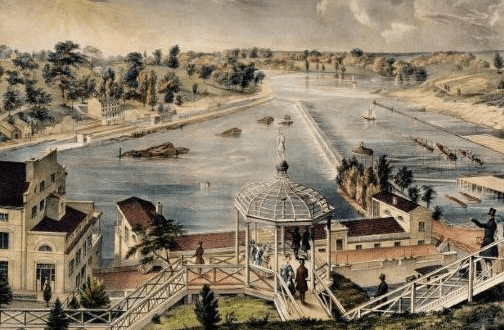
How did the facility area turn into a park?
For service to the city, F. Graff, Jr. was appointed Chief Engineer of Philadelphia’s Water Department. The man was promoted to such a position not only thanks to the progressive construction and water supply of the settlement but also because he improved the surrounding area.
Next to the waterworks, there was a stone quarry and storage site for wood steam engines. Later, this place became South Garden. A small pier was built there, where locals could go boating, as well as a new foot bridge across the entire territory of the water facility. Visitors to the park could enjoy the roar of the water flowing through the wheels and then go up to a small pavilion on the hills of the Schuylkill River.
In 1859, an updated structure was built on the dam mound to house three new turbines, which were installed only in 1872. The roof of the latter, also became a terrace, offering visitors a view of the river.
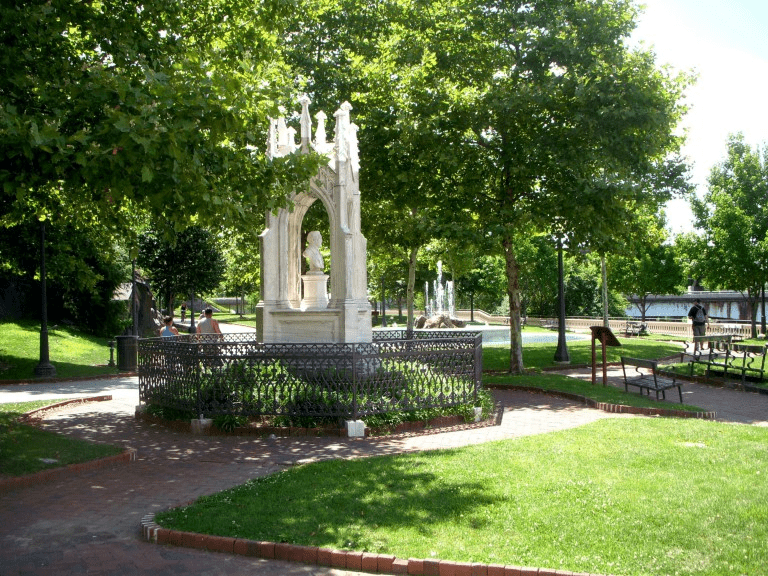
The end of the waterworks
Philadelphia was gradually expanding. New enterprises appeared, usually industrial ones, because of which the river constantly suffered. As a consequence, at the end of the nineteenth century, many residents began to suffer from a number of bacteriological diseases.
However, industrialization was eventually chosen. The waterworks have been decommissioned, and the reservoirs were turned into a “city aquarium.”
In 1962, local authorities installed a new public pool on the grounds of the waterworks, which would later be flooded by Hurricane Agnes. Only in the second half of the 20th century was the water facility remembered again. The Junior League started raising funds to restore the water supply.
That year, the league allocated twenty-four thousand dollars to the city to protect the buildings from the foul weather. In the future, American officials supported the request of a local public organization. The Secretary of the Interior granted the territory of the waterworks the National Historic Landmark status. All this contributed to the fact that at least as a natural zone, the historical heritage of the settlement was preserved.
This place is listed and is still in the National Historic Register and contains the major and historical exhibits. At the same time, the urban water flows from three water pumping stations that use slow sand filters to purify the river water. These plants are subordinate to the Philadelphia Water Department. The latter are engaged in solving all issues related to the maintenance of the pipe and other infrastructure, which guarantees clean water for more than one million residents and nearby suburbs.